
alpha glucose beta glucose
Glucose is an example of a carbohydrate which is commonly encountered. It is also known as blood sugar, and dextrose.
Its chemical formula is C6H12O6, and this empirical formula is shared by other sugars - called hexoses - 6 carbon sugars. You may wish to know in some detail how these 24 atoms are arranged in the molecule of glucose - the structural formula.
In some books you may see diagrams of the glucose molecule looking like this: This so-called stick diagram really only describes how things are in dry (powder) glucose.

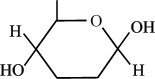
In life - in your blood and inside cells of plants and animals - most of the glucose consists of molecules shaped into a ring (actually a 6-sided figure, a hexagon) which may be drawn with this fairly simple format:

Note that there is an oxygen atom forming part of the ring, and that there are simple lines drawn making up the rest of the ring, and a section sticking out to one side. These lines represent carbon atoms, and -H and -OH groups, most of which have been left out for simplicity. Sometimes the details of just some of these -H and -OH gr oups are drawn in at one end (or both ends). This is because the orientation of these groups slightly alters the chemistry of the molecule, so the resulting molecules are given different names.
alpha glucose beta glucose
 In alpha glucose the -H group of the rightmost Carbon atom (C1) is above the plane of the ring, whereas it projects below the ring in beta glucose.
 Some of the lines may be thickened or flared out to give an impression of 3D structure on the page

All the other groups can vary in different hexose sugars, which result in slightly different chemical properties.
It is worth knowing the numbers used to describe each of the 6 carbon atoms.

This numbering is important when glucose units are joined together.
 1-4 linkages (formed by glycosidic bonding) result in a simple linear (end to end) connection, which is found in maltose, a disaccharide:

 Repeating the condensation process will result in the polysaccharide starch, which is considered to have 2 components, amylose and amylopectin.
The chain of 1-4 linkages so formed can be quite long, and may wind up into a helix. This is the situation in amylose, (a linear part of which is shown here):
Repeating the condensation process will result in the polysaccharide starch, which is considered to have 2 components, amylose and amylopectin.
The chain of 1-4 linkages so formed can be quite long, and may wind up into a helix. This is the situation in amylose, (a linear part of which is shown here):

 On the other hand, 1-6 linkage causes the formation of a branching point which then allows another chain of 1-4 linkages to develop. This 3-D branching also produces other points at which glucose may be added by condensation or removed by hydrolysis. This branching occurs in amylopectin, (a small section of which is shown here):

This basically explains the structure of starch and glycogen.